The Stillness That Compounds.
On equanimity, conviction, and holding quality through the noise.

Executive summary
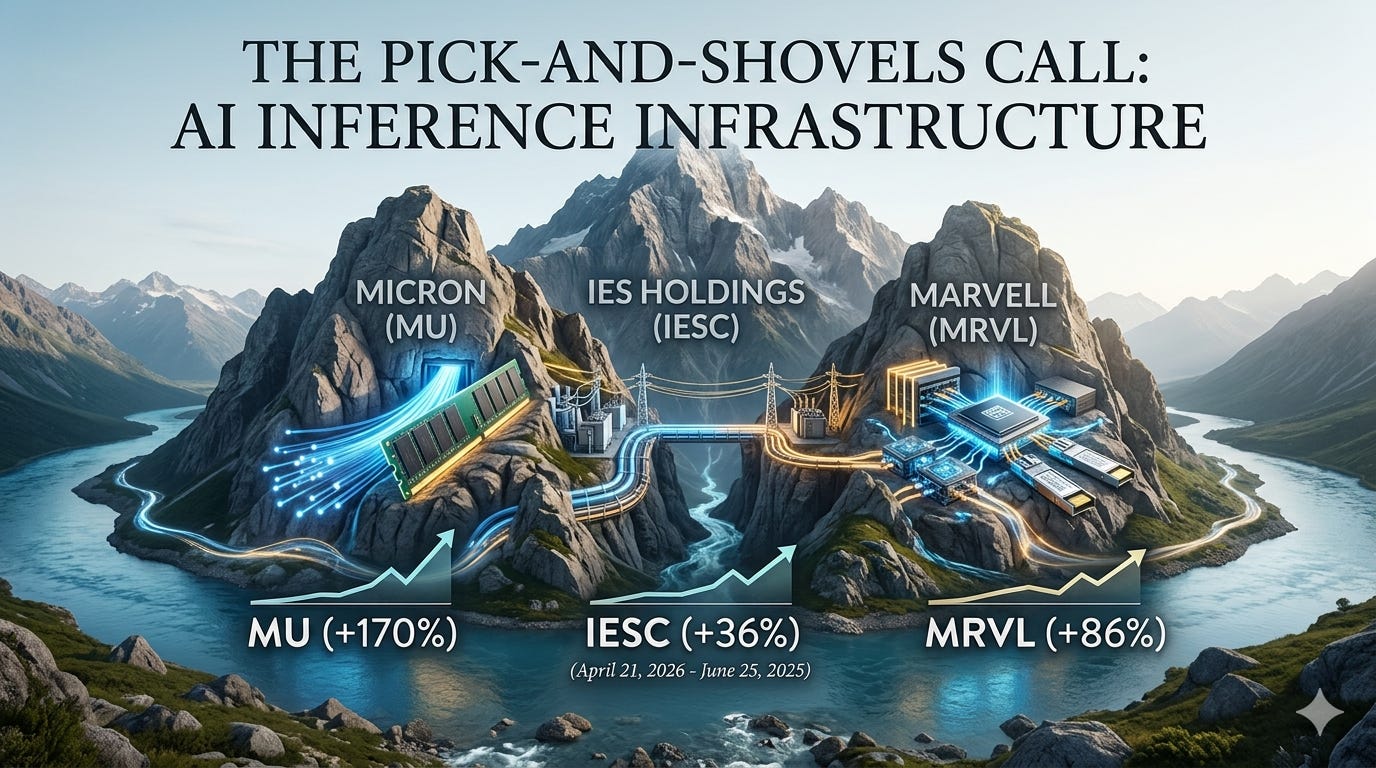
The call (April 21, 2026). The real leverage in the AI story is in the picks-and-shovels of the inference build-out, not the chatbots. On a Peter Lynch growth-versus-valuation screen I flagged three: Micron (MU), IES Holdings (IESC) and Marvell (MRVL).
The result (to the June 25 close). MU +170% ($449.38 → $1,213.56), IESC +36% ($564.19 → $766.54), MRVL +86% ($151.31 → $281.60).
The proof. On June 24, Micron reported its biggest quarter ever — ~$41.5B in revenue (+346% year-on-year), $25.11 non-GAAP EPS, HBM fully booked, and 16 customer agreements carrying ~$100B in minimum revenue commitments — the “contracted, multi-year demand” thesis written into binding paper.
The lesson. Be the mountain, and be the water. The mountain holds — still through the noise, rooted in what is real, unmoved by the weather. The water lets go — it does not argue with the rock, it finds the way around. Patience to sit. Humility to flow. Grounded enough to hold, fluid enough to release.
Prices and figures verified to the June 25, 2026 close. Nothing here is investment advice.

I spent last week in Banff, Lake Louise and explored other areas of God’s country.
There is a particular silence in the Rockies that you do not so much hear as feel. You stand at the base of something that has been there for sixty million years, and your own urgency — the inbox, the ticker, the takes — goes quiet for a moment. The peak does not perform. It does not flinch when the weather rolls across it: the cloud, the wind, the squall that empties the trail in minutes. The mountain was there before the storm. It will be there after. It is still. It is grounded. It simply is.
I came home thinking the mountain is the best investor I have ever met.
Because the hard part of this work is almost never the analysis. It is the noise. The daily chorus that tells you that you are wrong, that this time is different, that the thing you hold is a bubble about to burst. The weather is loud, and it is constant, and it is designed to move you.
The mountain does not argue with the weather. It just outlasts it.
The weather, lately, has been the “AI bubble”
For most of this year the loudest voice in the market has been the one calling the top. Every green day in AI infrastructure draws a fresh warning — circular financing, capex that will never earn its keep, a 1999 rerun coming any minute now.
Some of that is fair, and I have never pretended otherwise. On m3iresearch.com/ai-bubble I track exactly where the excess is building — concentration, stretch, and now a momentum signal that cools the read the moment tech genuinely rolls over. Froth is real. Crowding is real. I have no interest in waving it away.
But there is a difference between respecting a risk and letting it move you off the mountain. The naysayer and the disciplined investor are often looking at the very same froth. One of them sells the picks-and-shovels at a single-digit multiple because the headlines are loud. The other sits with a quieter question: has the underlying actually changed — or is this just weather passing across the rock?
What I wrote in April
On April 21, I published a piece on the agentic-inference supply chain — the unglamorous layer beneath the chatbots. The thesis was Jevons Paradox: cheaper inference does not shrink spending, it detonates it, because agentic workloads burn 5–30x more tokens per task than a chatbot. The demand was structural, not a fad.
I named three names — the rock, not the weather:
Micron (MU) — the HBM memory that is the binding constraint on inference, screening at a Peter Lynch PEG of 0.26, roughly 9x forward earnings, revenue up 196% year-on-year.
IES Holdings (IESC) — the electrical infrastructure inside the data centers, a PEG of 0.69, debt-free, its data-center segment growing 51% in a single quarter.
Marvell (MRVL) — the custom inference silicon hyperscalers are building to diversify beyond Nvidia, just as a third TPU partner (Google) was reportedly coming online.
The objection in April was the same one you will hear today: memory is cyclical, infrastructure is a commodity, the multiple is a trap, the whole complex is a bubble. The weather was loud.
The scoreboard since
I do not write this for a victory lap. I write it because the distance between the noise and the outcome is the entire lesson.
Micron (MU) closed at $449.38 on April 21. It closed at $1,213.56 on June 25 — +170%. Along the way it crossed a $1 trillion market capitalization and printed fresh all-time highs. And it handed us the cleanest illustration of this whole idea inside a single week: a chip sell-off knocked it below $1,060 on June 23 (the weather, screaming bubble) — and within 48 hours it reported the biggest quarter in its history and ripped roughly 16% higher. The “cyclical trough” the bears kept invoking turned out to be a structural, contracted, multi-year shortage (more on that report below).
IES Holdings (IESC) went from $564.19 to $766.54 — +36% — now a roughly $14–15 billion company printing fresh all-time highs, on the back of another quarter with its data-center-driven communications segment growing about 35%.
Marvell (MRVL) went from $151.31 to $281.60 — +86% — as the custom inference-silicon demand the April note was built on kept broadening, the reported Google TPU relationship among the catalysts.
The weather screamed bubble. The mountains compounded.
(April 21, 2026 and June 25, 2026 closing prices. This is a record of a published call, not a prediction of what comes next.)
What Micron just reported
The clearest evidence that this was structural — not a sugar high — landed after the close on June 24, when Micron posted the biggest quarter in its history:
Revenue of roughly $41.5 billion, up 346% year-on-year (from about $9.3B), well ahead of the ~$35B consensus, with non-GAAP EPS of $25.11.
Data-center revenue above $25 billion in the quarter — a $100 billion-plus annualized run rate — with data-center SSD revenue more than doubling sequentially.
HBM described as “fully booked,” the company guiding that the supply shortage persists well beyond 2027.
16 Strategic Customer Agreements signed, fourteen of them carrying cumulative minimum revenue commitments of roughly $100 billion.
Fourth-quarter guidance near $50 billion in revenue — several billion above the street.
CEO Sanjay Mehrotra put the backdrop plainly: “Our customers are recognizing that supply shortages in memory and storage will take considerable time to improve.” And on those contracts: “we expect approximately half or more of our company revenue to be under these” agreements.
This is the part the “memory is cyclical” bears could not model. The PEG of 0.26 I wrote about in April was never pricing a trough recovery — it was pricing a multi-year, contracted shortage. Micron just turned that thesis into signed paper.
Three tenets of the mountain
Banff did not hand me a stock idea. It handed me a posture — and each part of it, it turns out, was already written down by someone who did this far longer than I have.
Stillness — the patience of Buffett. The market, he said, is “a device for transferring money from the impatient to the patient.” The most expensive habit in this business is trading the weather; these names rewarded the absence of activity, not the presence of it. The mountain does not rebalance because a cloud went by.
Roots — the knowing of Lynch. Stillness without roots is just paralysis. Lynch’s whole framework is one instruction — “know what you own, and know why you own it” — paired with the warning almost nobody heeds: “far more money has been lost preparing for corrections than has been lost in the corrections themselves.” The base underneath these names — the PEG, the contracted demand, the cash flows — is what let me sit through the noise.
Courage — the conviction of Druckenmiller. Roots earn you the right to act. “It takes courage to be a pig,” he says: when the analysis and the conviction line up, the sin is timidity. And the lesson he took from Soros — “it’s not whether you’re right or wrong, but how much you make when you’re right and how much you lose when you’re wrong” — is just Buffett’s “be greedy when others are fearful” worn as a trade. June 23 was a day to be greedy.
Water — the other half of the mountain
But a mountain alone is not the whole picture. Stand by any alpine river and you meet its complement. Water takes the path of least resistance. It does not argue with the rock — it finds the way around it. Where the mountain holds, the water adapts.
Lao Tzu saw this twenty-five centuries before any of us had a ticker to watch. “Nothing in the world is softer than water,” he wrote in the Tao Te Ching, “yet nothing is better at wearing down the hard and the rigid.” The lesson is in how you hold it. Clench your fist around water and it is already gone; open your hand and it carries you. You do not fight a river, and you cannot cling to one. You float — you yield, and let it take you where it was always going to go.
That is the half the winners can make you forget: trade the market you have, not the market you want. Conviction is not marriage. The very names that rewarded stillness now carry risks I have no interest in pretending away — DRAM and HBM contract prices have run to stretched levels that price in a great deal of good news, and Chinese memory makers are scaling fast enough to be a genuine, structural threat to the same moat that made the trade work. None of that breaks the thesis today. All of it could tomorrow.
So the discipline that holds a compounder through a scare is the same discipline that pivots when the water changes course. Mountain energy is not only standing firm — it is refusing euphoria at the top, staying fluid in the mind even while the position is still, and being willing to change when the facts do. The river and the rock are not opposites. The investor who lasts is both: grounded enough to hold, fluid enough to let go.
The long view from the trail

By the time I reached the overlook, the squall that had cleared the path twenty minutes earlier was already gone. The light came back across the rock as if nothing had happened — because, to the mountain, nothing had. And below it, the river kept moving, finding its line, never once in the same place twice.
That is the whole game. The market will spend most of your life trying to convince you that the weather is the mountain. It is not. Your work is to find the rock — the real, structural, cash-generating thing — to size it with courage when the storm has everyone else running, to hold it with patience while the weather rages, and to move like water the day the river itself changes course.
So do the two hardest things in finance, at the same time:
Be still. And be ready to move.
M3I Research is for informational and educational purposes only. Nothing here is financial, investment, legal, or tax advice, or a recommendation to buy or sell any security. Quotations are attributed to their authors and used for illustration. The names discussed are a record of past commentary, and past performance does not guarantee future results. All investing involves risk, including the loss of principal. Do your own research and consult a licensed professional before making any decision.